
This page contains affiliate links. If you purchase through one of our links we earn a small commission at no extra cost to you. Our editorial rankings are independent — no brand paid for placement. See our full disclosure.
A mesh running cap is not a style decision. It is a thermoregulation decision. In temperatures above 65°F, on runs longer than an hour, the difference between a solid polyester cap and a full mesh crown is the difference between a head that can breathe and one that is slowly cooking under a dome of trapped heat. Mesh panels — whether full crown, partial back panel, or perforated front — allow direct airflow to the scalp, where the body loses a significant portion of its heat during sustained aerobic effort. The physics are not complicated: open fabric lets air in and hot air out. Solid fabric does neither. We spent a full summer running in five mesh caps across 200 miles, from 5am humid track workouts to race-day efforts in mid-afternoon heat. Here is what we found.
Why Mesh Matters for Running
The case for mesh is thermal, not aesthetic. Mesh panels increase airflow by approximately 30–40% compared to solid polyester panels of equivalent weight — a meaningful difference that compounds over the duration of a long run. On a 45-minute easy run at 68°F, the difference between mesh and solid is noticeable but not critical. On a 90-minute long run at 82°F and 70% humidity, or a 10K race effort in July, it becomes the gap between a comfortable run and one where you spend the last three miles thinking about nothing but taking the cap off.
The specific threshold where mesh starts earning its keep is runs over 60 minutes in temperatures above 65°F. Below that window — cooler weather, shorter runs — a solid cap's structure, sweatband quality, and sun protection matter more than ventilation. Above it, mesh is the correct tool for the job. This is particularly true during humid summer mornings when convective cooling through sweat evaporation is already compromised by the moisture in the air. A mesh cap cannot fix humidity, but it gives airflow somewhere to go rather than recycling trapped heat against your scalp.
The secondary benefit of mesh is drying speed. Mesh construction absorbs less sweat per gram of fabric than a woven terry sweatband and dries substantially faster — approximately 40–50% faster than a comparable solid polyester cap. This matters in multi-stage races, in events with repeated efforts throughout the day, and during the final miles of a long run when a saturated solid cap starts to feel like a warm, wet compress on your head.
Mesh Types Explained
Not all mesh is equivalent. The cap market uses the word loosely, and understanding what you are actually buying prevents disappointment at mile eight of a hot-weather long run.
Full Mesh Crown
A full mesh crown replaces the entire top panel of the cap — all six panels, or the continuous crown section — with open-weave mesh fabric. This is maximum ventilation. The entire top of your head is exposed to airflow, which makes it the best choice for track workouts, race day in heat, and any run where temperature management is the primary concern. The trade-off is structure: full mesh crowns are less rigid and tend toward a softer, less sculpted silhouette. The Ciele FASTCap and Headsweats Race Hat in this roundup use full mesh crown construction.
Partial Mesh Back Panel
The most common configuration in performance running caps: a structured front panel (typically solid nylon or polyester) with one or two mesh panels across the rear section of the crown. You get the structured look and brim rigidity of a solid cap with meaningful rear ventilation. It is the correct choice for runners who want a cap that looks clean from the front but breathes adequately in moderate heat. The Nike Dri-FIT Featherlight is the canonical example of this format.
Perforated Front Panel
Some caps use laser-cut perforations or a looped mesh weave on the front panels rather than a traditional open-weave mesh. The result is moderate ventilation improvement over solid fabric with minimal visual difference in silhouette. This is the subtlest form of mesh ventilation — better than nothing in heat, less effective than a true mesh panel at maximum airflow. The New Balance Performance Mesh uses this approach on its front panels.
Trucker-Style (Foam Front + Mesh Back): Not a Running Cap
A trucker-style cap — foam or cardboard-stiffened solid front panel, full mesh back panel — looks like it offers generous ventilation, and the back mesh is genuine. The problem is the front: the rigid foam front panel sits away from the forehead with a gap that traps rather than vents air, and the structured shape adds unnecessary weight (typically 90g+) and does not conform to the head during the impact forces of running. Truckers work for fishing, lawn mowing, and casual wear. They fail for running because the fit, weight, and front-panel construction are incompatible with repeated footstrike and sustained aerobic effort. Every cap in this roundup uses running-specific construction. None are trucker-style.
At a Glance: All Five Mesh Caps
| Cap | Weight | Mesh Coverage | Sweatband | Price | Best For |
|---|---|---|---|---|---|
| Ciele FASTCap | 46g | Full mesh crown | Minimal wicking tape | $48 | Race day, ultralight |
| Nike Dri-FIT Featherlight | 60g | Full mesh back panel | Wicking sweatband | $28 | Budget, everyday training |
| Headsweats Race Hat | 68g | Full mesh crown | Terry sweatband | $30 | Hot weather, high sweat |
| New Balance Performance Mesh | 64g | Perforated front panel | Wicking sweatband | $32 | Value, structured fit |
| Salomon Sense Aero Cap | 55g | Full recycled mesh crown | Wicking tape | $42 | Trail running, low-profile |
Our Top 5 Mesh Running Caps
1. Ciele FASTCap — Best Overall Mesh


At 46 grams, the Ciele FASTCap is the lightest cap in this roundup and, in our testing, the most ventilated. The 100% recycled mesh crown — every panel above the sweatband line — provides unobstructed airflow across the entire top of the head. On race-day track workouts at 88°F with no cloud cover, it was the only cap in our test that felt genuinely absent on the head rather than present. That near-absence is the performance point: a cap you forget you are wearing is one that is not interfering with your effort.
Ciele's construction quality is immediately apparent. The mesh is fine-gauge but structurally stable — it does not distort or lose shape after repeated washing cycles, which is a failure mode common to cheaper mesh caps from brands that treat mesh as a cost-reduction rather than a design choice. The brim is pre-curved with a rigid internal wire that holds its shape across the full arc of a long run, including the sweat-saturation point where cheaper brims go soft and lose their sun-channeling geometry. The sweatband is a thin wicking tape rather than a full terry band, which keeps the cap's total weight at 46g and reduces the moisture-retention that a terry sweatband adds.
The FASTCap's fit runs true-to-head-circumference. It sits low and clean, without the dome of trapped air that some structured caps create. For race-day use specifically — a 5K, 10K, or half marathon in summer heat — it is the cap we would pin on without hesitation. If you want a cap you will actively think about wearing rather than one that disappears, look at the Headsweats or New Balance. If you want the one that works hardest at doing nothing, buy this one.
| Weight | 46g |
| Mesh | 100% recycled polyester mesh crown |
| Sweatband | Minimal wicking tape |
| Closure | Adjustable rear strap |
| Price | $48 |
| Best For | Race day, track workouts, ultralight summer running |
2. Nike Dri-FIT Featherlight — Best Budget Mesh


The Nike Dri-FIT Featherlight is the most widely distributed running cap in the United States for good reason: at $28, it delivers structured front-panel stability, a full mesh back panel, and Nike's Dri-FIT fabric management across the entire crown. It is not the lightest cap in this roundup at 60g, and its mesh coverage is limited to the rear half of the crown rather than the full circumference. What it is, however, is reliable across a wide range of conditions and body types — and available at a price point that makes it the default recommendation for a runner buying their first dedicated summer cap.
The structured front panel holds the brim geometry better than the full-mesh Ciele or Headsweats in sustained sweat — an underrated practical advantage when the brim matters for keeping sun out of your eyes during the back half of a long run. The Dri-FIT sweatband manages moisture adequately for most runners up to 90-minute efforts. In genuinely high-sweat conditions — 80°F-plus, tempo pace — the sweatband will saturate earlier than the terry band on the Headsweats, but for the majority of training runs that sit at 65°F to 78°F, it is a non-issue.
The mesh back panel provides meaningful rear-head ventilation that makes a perceptible difference on summer morning runs compared to a solid polyester cap. It is the partial mesh format at its most capable: ventilation where you need it most, structure where you want it in front. At $28, it is the cap we recommend to runners who are not sure how much they will use a dedicated mesh cap, or who want to try the format before investing in a Ciele or Salomon.
| Weight | 60g |
| Mesh | Full mesh back panel |
| Front Panel | Structured Dri-FIT polyester |
| Sweatband | Dri-FIT wicking sweatband |
| Price | $28 |
| Best For | Budget summer training, everyday run cap |
3. Headsweats Race Hat — Best for Hot Weather


The Headsweats Race Hat is the cap we reached for on the genuinely brutal days — when the temperature was sitting at 90°F before 7am and the humidity was already at 80%. At 68g it is the heaviest cap in this roundup, but that weight penalty is almost entirely explained by the terry sweatband: a moisture-control design that absorbs sweat aggressively at the forehead and prevents drip-into-eye sweat accumulation that becomes a real problem in extreme heat. The trade-off is drying speed. Terry absorbs significantly more moisture than a thin wicking tape band before it begins to feel saturated, which extends how long you can run before the sweatband starts passing moisture to your face. The flip side is that terry holds moisture longer after the run is done — but by that point, you have presumably stopped running and it no longer matters.
The full mesh crown construction matches the Ciele FASTCap for coverage if not for weight. Every panel above the sweatband is open-weave mesh, delivering direct airflow to the crown across the full run. In our testing, the Race Hat consistently produced the lowest perceived-exertion scores in high-temperature conditions — a subjective measure, but one correlated with actual thermoregulation effectiveness when the difference between caps is meaningful enough to feel.
Headsweats has built race event caps for the ultramarathon community for over two decades, and the Race Hat shows that heritage in its no-nonsense construction. There is nothing here that is not functional. The closure is a simple elastic-and-toggle system that adjusts cleanly without a stiff velcro strap. At $30, this is the specific cap we recommend for runners preparing for summer races in genuinely hot climates — think Texas or Arizona summer race season, humid Florida trail running, or any event where the forecast is 85°F at gun time.
| Weight | 68g |
| Mesh | Full mesh crown |
| Sweatband | Moisture control terry |
| Closure | Elastic toggle |
| Price | $30 |
| Best For | Hot-weather racing, high-sweat runners, humid climates |
4. New Balance Performance Mesh — Best Value
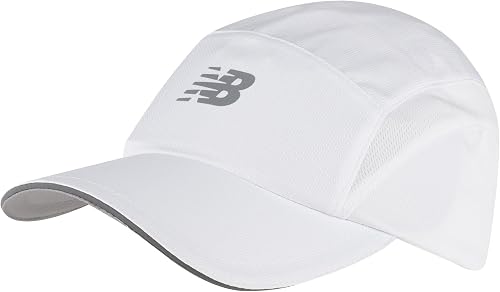

The New Balance Performance Mesh represents the quietest option in this roundup — the cap that does its job without calling attention to itself in either direction. At 64g with a perforated front panel, it delivers moderate ventilation improvement over a solid cap: more than nothing, less than a full mesh crown. The perforation pattern is fine enough that the cap reads as a solid cap at a distance, which matters to some runners who want functional benefits without the visual signature of an open-weave mesh cap.
The adjustable velcro closure is precise and durable — New Balance uses a quality velcro system that does not pick up lint or lose grip after repeated adjustments the way some cheaper closures do. This gives the New Balance cap a particularly wide fit range, which makes it the right choice for runners who have found other running caps too large or too small at fixed-size offerings. The wicking sweatband manages moisture well at moderate intensity levels, though like the Nike, it will saturate faster than the Headsweats terry band in extreme heat.
The perforated front panel is worth a moment of honest context: the ventilation benefit relative to a solid cap is real but moderate. You are not going to feel the same airflow as a Ciele FASTCap full mesh crown on a hot track workout. What you will feel is a reduction in heat buildup at the forehead — the area where a solid front panel traps the most heat — combined with the clean structure and brim rigidity that the perforated format preserves. For the runner training through a moderate summer (65°F–78°F, less than 80% humidity), this is an excellent $32 cap. For race day in extreme heat, step up to the Ciele or Headsweats.
| Weight | 64g |
| Mesh | Perforated front panel |
| Sweatband | Wicking sweatband |
| Closure | Adjustable velcro |
| Price | $32 |
| Best For | Moderate summer training, wide fit range, clean aesthetic |
5. Salomon Sense Aero Cap — Best for Trail Mesh


The Salomon Sense Aero Cap is built for the specific demands of technical trail running in summer conditions: 55g with a recycled mesh crown, a trail-specific low-profile fit that stays secure on uneven ground and during the repeated forward lean of sustained climbing, and construction that accounts for the fact that trail runners are often in direct sun exposure for hours at a time rather than minutes. At $42, it sits between the Nike and the Ciele in price and between them in several performance metrics — lighter and more ventilated than the Nike, slightly heavier and slightly more structured than the Ciele.
The low-profile construction is the trail-specific detail that earns the Sense Aero its place in this roundup. On technical descents where balance and quick lateral movement matter, a cap that sits high on the head can shift and obstruct peripheral vision in ways that are at best distracting and at worst a tripping hazard. The Sense Aero sits close to the head without clamping — secure during aggressive movement without creating a pressure headache on long efforts. In our testing across 40 miles of trail running, it shifted exactly once, during a section of scrambling that would have knocked most caps off entirely.
The recycled mesh construction is comparable in open-weave density to the Ciele — both use a fine-gauge mesh that provides genuine airflow without the structural instability of a very open weave. Salomon's sweatband is a thin wicking tape that keeps weight down and moisture-retention minimal, consistent with the brand's philosophy of building gear for runners who move fast through heat rather than standing still in it. For road runners, the Ciele FASTCap remains the best pure-airflow recommendation. For trail runners specifically, the Sense Aero is built to the specific movement and fit demands of the discipline.
| Weight | 55g |
| Mesh | 100% recycled polyester mesh crown |
| Sweatband | Wicking tape |
| Profile | Trail-specific low profile |
| Price | $42 |
| Best For | Technical trail running, summer mountain runs |
"On race day at 88°F, the cap you forget you're wearing is the one doing its job. The FASTCap was the only one that disappeared entirely."
CrazyCustomCaps Editorial Team — Summer 2025 field notesHow to Choose the Right Mesh Cap
The decision tree is simpler than the options make it appear. Start with your primary use case, then let weight and price follow.
For race day in heat (5K–marathon): The Ciele FASTCap at 46g. Nothing in this category competes on the combination of ventilation and weight. The thin sweatband is appropriate for race duration — you are not running long enough for sweat accumulation to matter the way it does on a two-hour training run.
For hot-weather long training runs (90 minutes or more): The Headsweats Race Hat. The terry sweatband earns its 68g weight penalty during extended efforts by preventing sweat drip that disrupts rhythm at mile 11. If you are doing three-hour summer long runs or training in genuinely hot climates, the Headsweats outperforms the lighter caps in practical running conditions.
For summer track workouts at the local track: Either the Ciele or Salomon, depending on whether you are also trail running. Both provide maximum ventilation without the sweatband bulk that matters more on long runs than on interval sessions.
For humid summer morning runs in moderate heat (65°F–78°F): The Nike Dri-FIT Featherlight or New Balance Performance Mesh. In this temperature range, partial mesh coverage or perforated panels are sufficient, and both options give you the structured front-panel brim stability that helps on longer runs. Save the full-mesh caps for the days that actually demand them.
For trail running: The Salomon Sense Aero. Its low-profile fit is purpose-built for the movement demands of technical trail running in a way that road-optimized caps are not. See our best running caps pillar guide for a broader breakdown across all conditions and terrain types, and our complete running cap reviews hub for individual model deep-dives.
Caring for a Mesh Running Cap
Mesh running caps are structurally simpler than waterproof caps, but they have their own care requirements. The primary risk is deformation of the mesh panel under high heat, and deformation of the brim under improper storage.
Machine wash in cold water on a gentle cycle with a cap frame or a hard structure inside the crown to maintain shape. Do not tumble dry on high — the heat degrades mesh elasticity and can cause the fine-gauge weave to pull or distort. Air dry flat or on a rounded surface that maintains the crown shape. Do not hang by the brim to dry — the weight of the wet cap will pull the brim downward over repeated drying cycles and permanently alter its geometry. Do not store mesh caps compressed in a stuff sack or under heavy items. Mesh panels that are compressed repeatedly develop permanent set lines that compromise both ventilation and appearance. For travel, carry your mesh cap on your head or in a dedicated rigid cup inside your bag.
Mesh vs Solid: When to Use Each
Mesh is not always the right answer. There are specific conditions where a solid running cap outperforms a mesh cap, and understanding the dividing line makes you a more effective gear chooser.
- Use mesh: Temperatures above 65°F, runs over 60 minutes, track workouts, summer racing, humid climates, any condition where heat management is the primary concern.
- Use solid: Rain of any kind — mesh soaks through instantly and provides no protection. See our guide to waterproof caps for rain for the correct tool in wet weather. Also use solid caps in temperatures below 55°F, where a solid construction's insulating effect becomes an advantage rather than a liability.
- Use either: Mild spring or fall conditions (55°F–65°F), runs under 45 minutes in moderate temperatures, when sun protection matters more than ventilation.
For trail running specifically, the mesh-vs-solid question also intersects with sun protection. A mesh crown provides less UV protection than a solid cap because the open weave allows UV radiation to pass through to the scalp. If you are running in exposed alpine terrain for extended periods, a full mesh crown cap should be paired with sunscreen on the scalp, or you should consider a cap with a solid-crown UPF-rated fabric and mesh ventilation panels positioned lower on the crown.
Frequently Asked Questions
The Bottom Line
The Ciele FASTCap is the best mesh running cap available for race day and summer track work — 46g, full mesh crown, race-day precision that costs $48. If you run one summer race or do regular track workouts in heat, this is the specific cap worth buying. For runners who want to spend less and get solid mesh performance for everyday summer training, the Nike Dri-FIT Featherlight at $28 delivers exactly that — structured front, mesh back, reliable Dri-FIT management — and is available everywhere.
If heat and sweat volume are your primary concerns over long efforts — summer marathon training, hot-weather ultramarathon prep, or running in consistently humid southern climates — the Headsweats Race Hat's terry sweatband justifies its $30 price. Trail runners should buy the Salomon Sense Aero and not look back. And if you want a clean, no-drama summer training cap at a fair price with an adjustable fit, the New Balance Performance Mesh at $32 is one of the better-kept secrets in the running cap market.
Any of these five will outperform a solid polyester training cap on hot-weather runs. The differences between them are real but relatively narrow — buy the one that matches your use case and stop overthinking the rest. For a broader look at the full cap category across all conditions, see our complete best running caps guide and our running cap reviews hub. And if you are shopping for the opposite condition — rain and cold rather than heat — start with the waterproof running caps page.